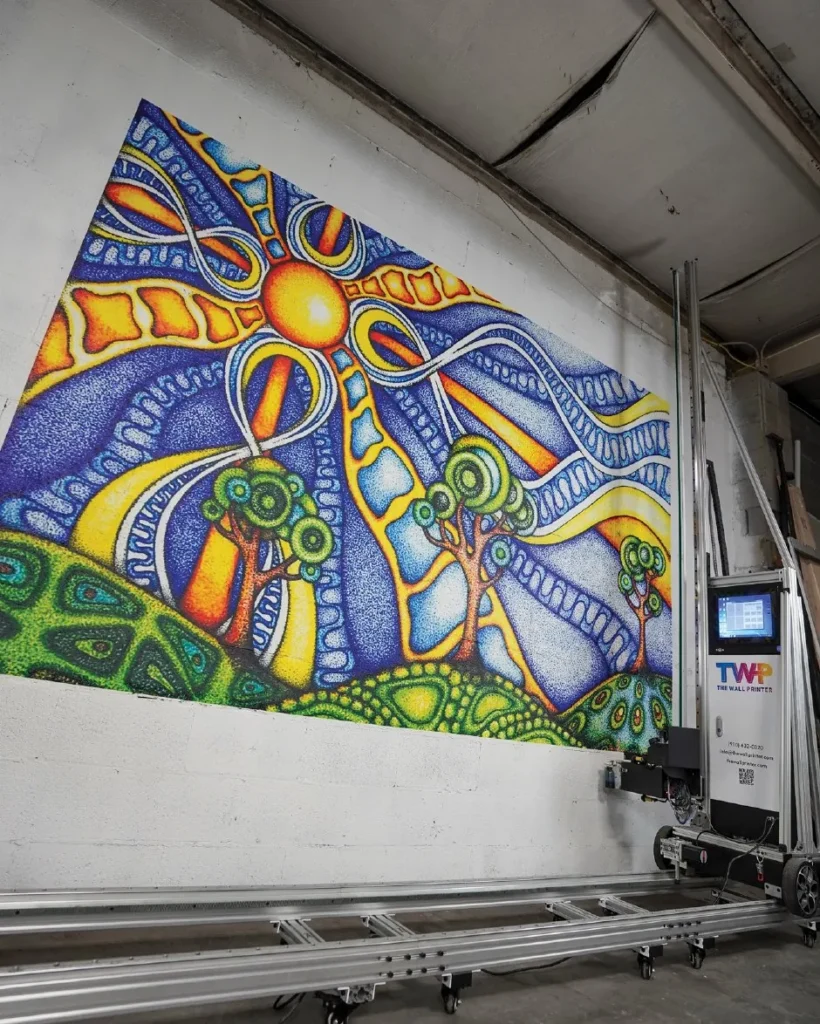
Most interior walls in decent shape print well. Some walls need work first, and a few aren’t worth printing at all, whatever the client offers. Turning down a wall that’s going to fail is better for you than printing it and getting the call six months later. Here’s what to check before you say yes.
Damp walls
If a wall is wet, sweating, or shows white powdery salt on the surface, the problem is the wall, not the print. Ink sits on the surface, and if the surface is moving or flaking, the print goes with it. Find out where the moisture is coming from before anything gets printed.
Peeling, chalky or flaking paint
A print is only as stable as the paint under it. Rub the wall with your hand. If paint comes off, it needs to be scraped, primed and repainted before you print.
Fresh paint
Newly painted walls need to cure. Follow the paint maker’s cure time before printing, and build that wait into the schedule with the client.
Deep texture
The printer handles brick, block, wood and light texture well. Very deep texture is different. Corrugated metal is too deep, and we tell people to avoid it. The print head runs close to the surface, and deep ridges mean uneven coverage or a head that touches the wall.
Walls taller than 11 feet
The printer prints up to 11 feet high. Past that, you need a plan for the rest of the wall, whether that’s a design that stops at 11 feet or another method for the top. Agree on it with the client before you quote.
Walls you don’t have permission to print
Renters, tenants in a shared building and businesses in leased space often need the landlord’s sign-off. Get it in writing. Our article on landlord permission covers what to ask for.
Outdoor walls
Exterior walls can be printed, but sun, weather and the wall itself all matter. Every outdoor job is different. Talk it through with the team before you quote one, and they’ll give you a recommendation for that wall.
A quick pre-job checklist
- Photos of the whole wall and close-ups of the surface
- Dry to the touch, no salt or staining
- Paint firm, not chalky, and fully cured
- Texture shallow enough for the print head
- Design fits within 11 feet of height, or there’s a plan for the rest
- Written permission from whoever owns the wall
- Power and floor space for the printer
Questions people ask
Can you print on any wall?
Most interior walls in good condition print well. Damp walls, flaking paint, uncured paint and very deep texture like corrugated metal need work first or aren’t worth printing.
How tall can the printer print?
Up to 11 feet high. Taller walls need a plan for the area above that.
Can you print on an outdoor wall?
Yes, but every outdoor job is different. Talk to the team first and they’ll give you a recommendation for that wall.
Thinking about a printer? Tell the team in Wilmington what you want to print and where, and we’ll give you a straight answer on whether it fits.
Before you buy: straight answers to the questions buyers ask us.
- The first 90 days with a wall printer: what actually happens
- Five assumptions that make any wall printer calculator look better than real life
- How a $500 wall printing job can lose money
- Print heads: what wears out on a wall printer, what it costs and how to make it last
- Walls to think twice about before you print on them
- Where a wall printer struggles, and how owners plan around it
- A $40,000 printer package or a cheap import: what you’re actually comparing
- What support looks like after you buy a wall printer
- Who shouldn’t buy a wall printer
- What it takes to do well with a wall printer: the five pillars
- Questions to ask a wall printer owner before you buy
- The three kinds of wall printing jobs, and what each one sells for
- How fast does a wall printer print?