Direct-to-wall printing has grown up. A few years ago it was the machine that stopped people in their tracks at trade shows. Today it’s a real commercial service, and the people looking into it are asking sharper questions: What does the equipment really cost? What does the work pay? Does the business hold up after the first few jobs?
We spend our days with wall printer owners, on job sites, on support calls, and in our owner community, so we hear these questions constantly. Here are honest answers, including a few that sellers of cheap machines would rather you didn’t ask.
1. What is wall printing, and how does a wall printer work?
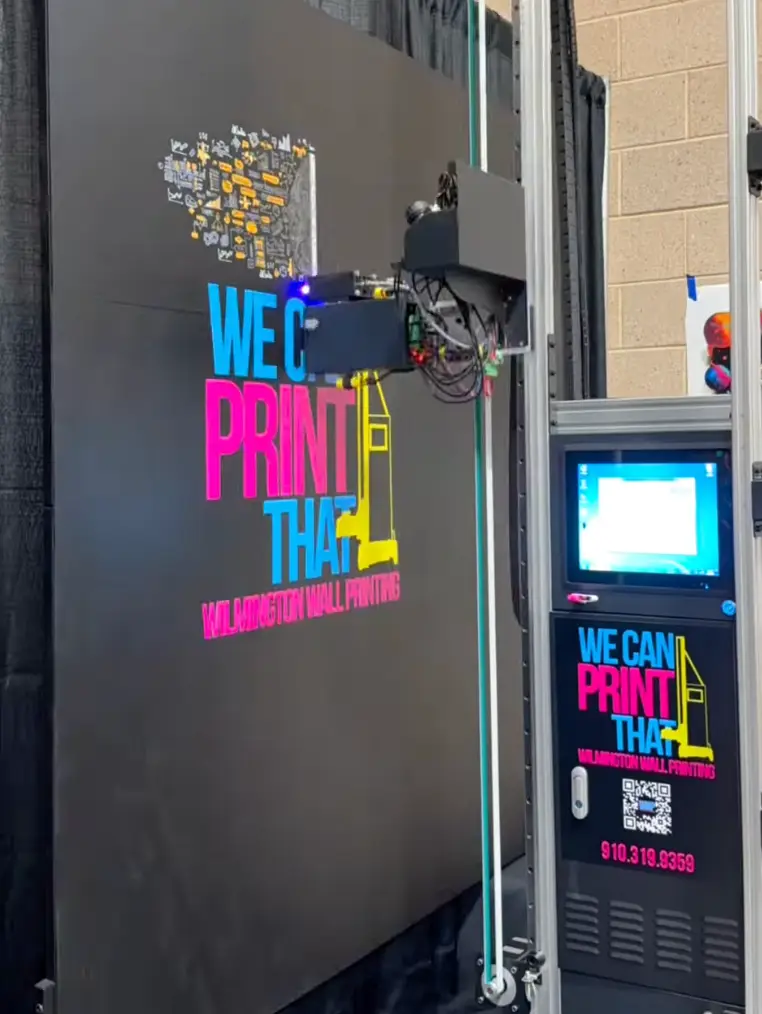
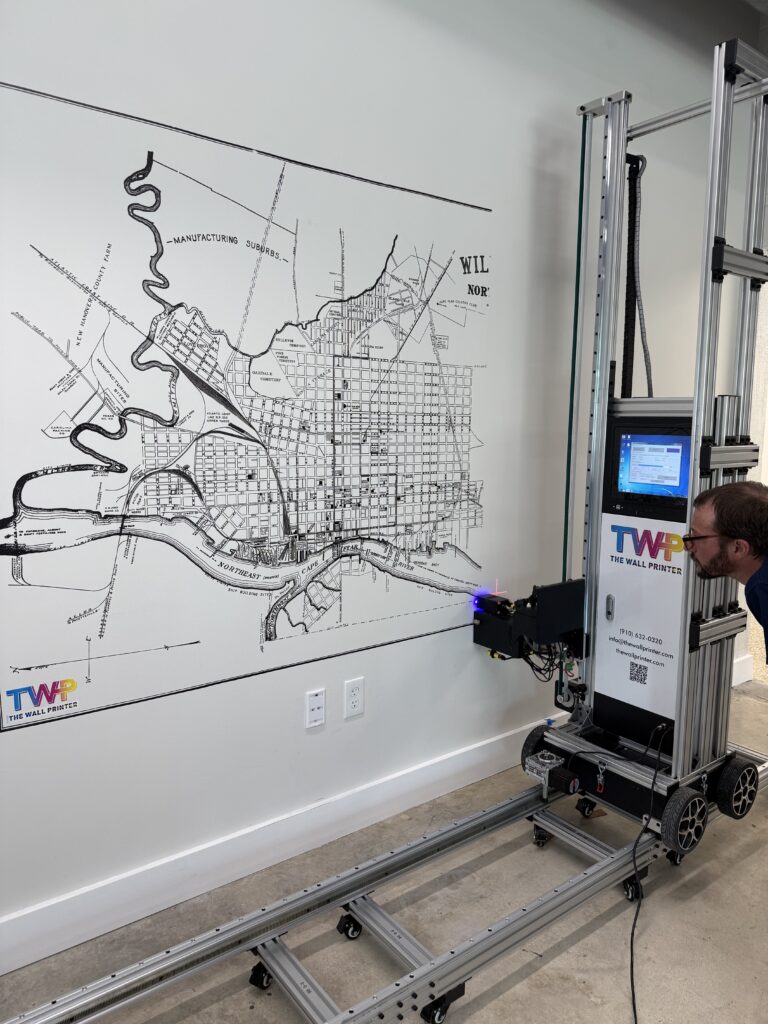
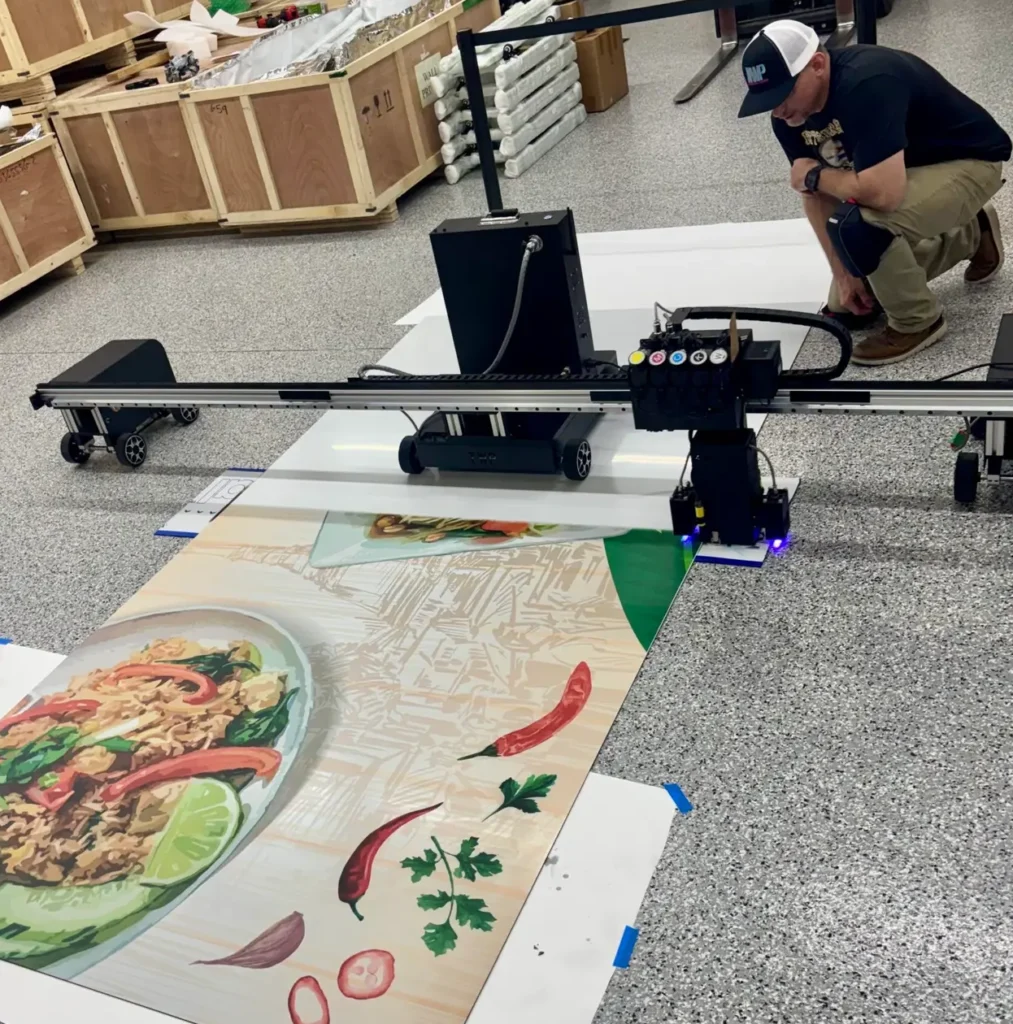
Wall printing means printing a digital image directly onto a wall or other vertical surface with a vertical UV inkjet printer. The machine stands on the floor, travels along a track, and prints in vertical passes while UV light cures the ink instantly. No vinyl, no adhesive, no waiting for anything to dry.
The easiest way to picture it: a large format inkjet printer turned on its side and brought to the job. The operator prepares the design file, positions and calibrates the machine at the wall, and the printer reproduces the image at exactly the right proportions. Because the ink cures the moment it lands, the space is ready to use as soon as the print is done.
That’s the key difference from vinyl. Vinyl graphics are printed on adhesive film, transported to the site, and installed by hand, panel by panel. A wall printer puts the image straight onto the surface with no film, no adhesive, and no lamination.
2. How much does a wall printer cost?
Wall printers range from about $3,000 to $60,000. Budget imported machines sit at the low end. Commercial-grade machines with U.S.-based support, training, and parts availability generally start around $40,000. But the sticker price is the least important number. What matters is total cost of ownership: printheads, ink, downtime, and what happens when something breaks in the middle of a job.
Industry pricing guides published this year put the market between roughly $4,000 and $60,000, depending on features, brand, and intended use. Online marketplace listings go even lower, but those machines usually come with little support, if any.
What drives the price difference:
Printhead quality. Cheaper machines often use printheads that clog easily. One overseas manufacturer’s own buyer guide warns against machines with refurbished printheads that clog and throw constant error codes. At TWP, we’ve tested and refined our technology for years, and we’re still improving it.
Software. Ask whether the software is included outright, sold as a subscription, or locked behind feature fees. Every TWP printer includes all the software, updates, and systems you need to start printing, at no additional cost.
Support and parts. A machine that sits idle for three weeks waiting on an overseas part costs you more than whatever you saved up front. TWP support comes with the life of your printer, with no added cost and no limits.
Training. Setup, calibration, file prep, and surface prep all take real learning. So ask: who teaches you, and for how long? TWP owners get comprehensive, in-person training at our Wilmington, NC headquarters, plus ongoing support from a team that typically responds within an hour, seven days a week.
The honest takeaway: a $6,000 machine and a $40,000 machine aren’t the same purchase. One is equipment. The other should come with a support system behind it. Before you decide, ask yourself what a $6,000 machine costs you if it ends up sitting in the garage as a very expensive clothes rack.
3. Is a wall printing business profitable?
Absolutely it is. Material cost per square foot is low, and pricing is based on the value of the finished wall, not the cost of the ink. But here’s the part people skip: profit comes from booked jobs, not from owning the machine. Owners who treat this as an active sales business build real revenue. Owners who wait for the phone to ring end up with an expensive machine and no customers.
The margin math is what gets people excited, and it’s real. Ink typically runs around $0.50 per square foot on commercial-grade systems. A practical way to model any job: your revenue is a minimum charge, plus printed area times your rate, plus add-ons. Net profit comes after labor, travel, and overhead. You can run your own numbers with our ROI calculator.
A quick example: a 300 square foot restaurant feature wall at $15 per square foot brings in $4,500 against roughly $150 in ink. Ten jobs like that covers the cost of a $40,000 machine, before labor, travel, and overhead. That’s gross math, not a promise. Your real results depend on how many jobs you close each month.
What eats into profit is well known: labor time, travel time, and rework. Equipment downtime is the other big one. This is where who you buy your printer from comes in handy. And plan for marketing from day one. One industry guide recommends setting aside 10 to 15 percent of revenue for ads and branding. See what your profit margins could be with our ROI Calculator.
4. How much do wall printing businesses charge per square foot?
Pricing varies widely by market. Owners in our community commonly charge $20 to $45 per square foot for standard work, with premium, complex, or high-access projects priced higher. Most also set a job minimum to cover travel and setup, and charge separately for design and wall prep. Where you land depends on your location and what your local market will support.
Some published industry guides quote lower numbers, which is exactly why local positioning matters. One manufacturer tells new owners that if they can’t win commitments at $15 to $35 per square foot, the problem is the pitch, not the printing. We agree: how you sell the outcome shapes what you can charge.
Pricing structure that works:
A job minimum, so small residential requests still cover setup and travel.
A per square foot rate that reflects complexity, surface, and access (lift work costs more).
Add-ons: custom design, surface prep, protective clear coat, after-hours scheduling.
Remember that commercial clients aren’t buying square footage. They’re buying outcomes: a finished lobby, a branded hallway, a menu wall ready for Friday’s grand opening. Price for the outcome.
5. What surfaces can a wall printer print on?
Commercial wall printers can print on most interior surfaces and many exterior ones, including painted drywall, plaster, brick, concrete, wood, glass, ceramic tile, and metal. Textured and uneven surfaces are possible too, but results depend on how well the machine adjusts for surface variation and on proper prep.
Across the industry, common printable surfaces include drywall, painted walls, plaster, brick, concrete, wood, glass, tile, metal panels, and acrylic. One of the biggest advantages over vinyl: brick, concrete, wood grain, and plaster keep their natural texture and character, with the artwork living right on the surface. Want to see what our owners have printed on? Our YouTube channel is full of examples, and some of them are genuinely surprising.
Now the honest part: surface prep matters. Dust, grease, glossy finishes, and deep texture all affect adhesion and sharpness. Skeptics in the sign industry like to point out that no wall is perfectly flat, and they’re right. That’s exactly why we put so much weight on machine quality and operator training. Those two things are what separate professional results from amateur ones. On any unfamiliar surface, always run a test patch first.
Check out our YouTube channel to see what our customers have printed on (hint, it’s super cool)
6. How long does a wall print last, and can it be removed?
Properly cured UV prints on prepared interior walls last for years under normal conditions. Exterior prints face sun and weather, so they typically get a protective clear coat to extend their life. And wall prints don’t peel off like vinyl. When a client wants a change, the wall simply gets painted over. No damage, no drywall repair.
On durability, UV printing research broadly agrees that quality UV inks with UV-stabilized pigments hold their color indoors for a decade or more. Outdoors, prints typically show minimal fading for three to five years, depending on sun and weather exposure. Cured UV ink also stands up to common cleaning products, alcohol, and mild solvents, which matters a lot in hospitals, schools, and restaurants where walls get wiped down daily.
If a client truly needs a removable graphic, say a short-term promotion in a leased space, vinyl may be the better fit, and a good wall printing business will tell them so. Just know that vinyl removal comes with its own risk: pulling it off drywall can tear paper and paint, leaving repairs behind.
7. Is wall printing better than vinyl wraps or hand-painted murals?
Each method has its place. Wall printing wins on speed, accuracy, seamless finish, textured surfaces, and lifecycle cost. Vinyl works better on curved surfaces or in tight spaces where a printer can’t operate. Hand-painted murals are the right call when a client wants a one-of-a-kind piece from a specific artist. None of these replaces the others. More options just mean a wider range of jobs you can say yes to.
How they compare in 2026:
Hand-painted murals. Beautiful and unique, but slow and dependent on an artist’s availability. One commercial buyer’s guide puts them at $20 to $50 per square foot, with longer installation windows and more schedule risk.
Vinyl wraps. Faster than paint and removable, but the same guide estimates $12 to $18 per square foot installed, plus area closures, lift rental, future removal, and a refresh every three to five years, with edges that can lift in humid spaces. Vinyl also shows seams and struggles on brick and concrete. In hospitals and schools, applied wall coverings must meet strict flame-spread requirements, and printing directly on the wall adds no extra layer to the surface.
Direct-to-wall printing. Seamless, no adhesive, and it handles textured surfaces. Our owners regularly complete a 200 square foot mural in a single shift, which means hospitals, schools, and offices can stay open while the work gets done.
Wall printing makes the strongest case for multi-location brands. A hotel chain with 50 properties can’t hire 50 different mural artists and expect consistent results. It’s equally strong for hospitals and schools that have to meet state and federal requirements around fire safety and air quality.
8. Do I need design or printing experience to start a wall printing business?”
No, and that’s one of the best parts of this business. What you do need is a willingness to learn and a willingness to sell. Running the machine, calibrating it, and preparing files are all trainable skills. The harder skills are estimating jobs, prepping surfaces, and closing commercial clients. The owners who succeed treat this as a business they’re building, not a machine they’re operating. Over the past seven years, we’ve built programs and resources around exactly that.
Here is what you actually need to learn:
Machine setup, calibration, and routine printhead maintenance.
File preparation: resolution, scaling, and color management for large formats. Knowing Photoshop, or having a designer you can call, helps.
Surface assessment and prep. We’ve built a repeatable process for this, too.
Estimating and quoting.
Sales and marketing to commercial buyers.
A design background is a plus, not a requirement. Plenty of owners partner with freelance designers or start with image libraries on their first jobs. What matters more is choosing a manufacturer that offers ongoing training and a support team you can reach when a job goes sideways, because at some point, one will. If you want the full picture of what it takes, talk with Jason Ott , our Business Development Director.
9. Is a wall printing business a franchise?
Most wall printing businesses aren’t franchises, and TWP isn’t either. You buy the equipment, build your own brand, and keep 100 percent of your revenue, with no royalties or franchise fees. The tradeoff is that your success depends on your own effort, which is why the training, support, and community behind your equipment matter so much.
This distinction matters when you’re comparing opportunities. A franchise gives you a brand and a system in exchange for ongoing fees and restrictions. An equipment-based business gives you ownership and independence, but you’re the one who has to execute. TWP owners get proven equipment plus a support team and an owner community behind them the whole way.
Questions to ask any manufacturer before you buy:
Where is support based, and what are the response times?
How fast can I get replacement parts?
Is training one-time or ongoing?
What does the warranty cover, for how long, and can I extend it?
Is there an owner community I can learn from?
Can I talk to current owners, including ones who have struggled?
A seller who can’t answer these clearly is selling you a machine, not a business.
10. How do wall printing businesses get customers?
The strongest wall printing businesses focus on commercial clients: restaurants, hotels, offices, schools, healthcare facilities, gyms, and retail. They win work through local marketing, before-and-after video, partnerships with designers and contractors, and direct outreach. Residential jobs are great for building a portfolio, but commercial accounts are what build revenue.
Channels that work:
Local search. Set up and optimize your Google Business Profile and target searches like “wall printing in [your city].” Build three to five strong case studies, post short videos, and partner with interior designers and contractors for referrals.
Video. A wall printer at work is naturally fun to watch. Timelapses and before-and-afters are your best organic content, hands down.
Showcase projects. One high-visibility wall for a local nonprofit or a busy coffee shop can bring in more leads than a month of ads. The crowd that gathers to watch becomes your sales funnel.
Trade partnerships. Interior designers, general contractors, sign shops, and property managers all have clients who need walls.
Direct outreach. Most commercial buyers don’t know direct-to-wall printing exists yet. Your first job is to educate. The quote comes second.
The bottom line
A wall printing business is a real opportunity with real margins, but it isn’t a shortcut. The equipment matters. The support behind it matters more. And your willingness to sell matters most of all. If you’ve run a business before and you want something creative with room to grow from one machine to a fleet, it’s worth a serious look.
Want to see the real numbers for your market? Join a 25-minute live session where our business development team walks through the equipment, operating costs, and a five-year cost comparison. No fluff, no sales and a live Q&A so you can get direct answers to your questions.