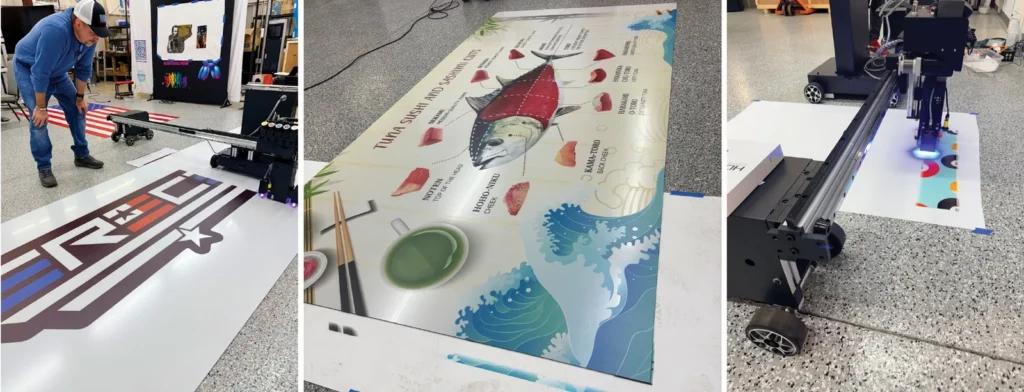
Surface printing puts UV-cured ink straight onto the surface. Printed vinyl is a graphic printed on adhesive film, usually laminated, then applied by an installer. For a long-term graphic on a surface you control, direct printing has one material cost, ink at about fifty cents a square foot, and no film, lamination, adhesive or vinyl installer. Vinyl is still the better call for temporary graphics, leases that forbid paint, curved or deeply textured surfaces, very large runs of identical decals, and outdoor work that needs a long life with no clear coat.
The Wall Printer® assembles, tests and supports direct-to-surface UV printer packages for walls, floors, glass, metal, wood and panels in Wilmington, NC. We’d rather you pick the right method than our method, so this covers both sides.
What’s the difference between surface printing and vinyl?
Printed vinyl is a three-step product. A shop prints the graphic onto film, laminates it, and ships it. Then an installer applies it, works out the air and trims the edges. It sits on top of the surface, held there by adhesive.
Surface printing skips the film. On vertical surfaces, a UV inkjet head travels along a track set against the surface. On floors, the Floor Series rolls across the surface on four belt-driven wheel housings. Either way, the image goes straight onto the surface, and UV light cures the ink as it prints. There’s nothing to ship and nothing to apply.
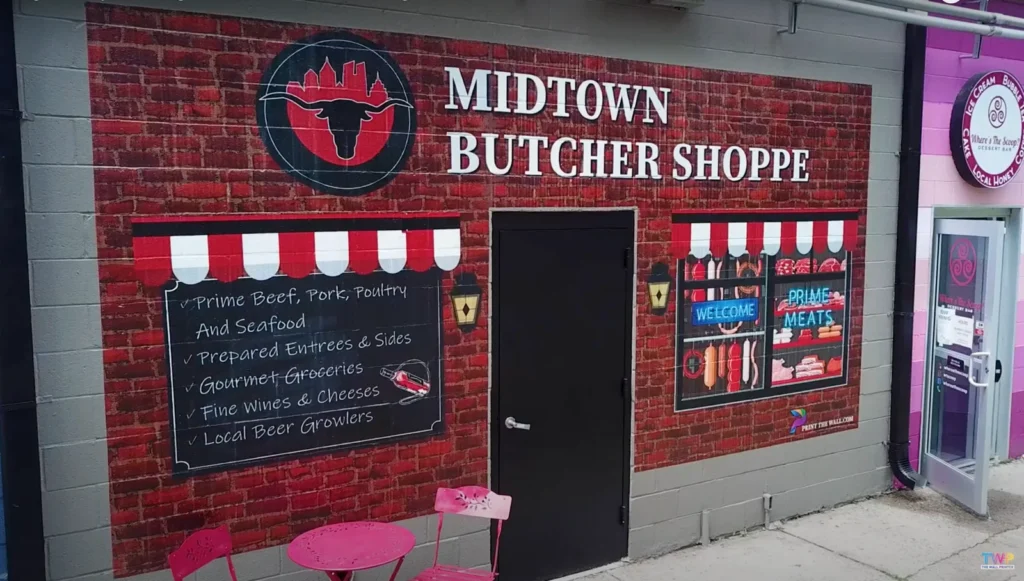
The direct method prints on walls, floors, glass, metal, wood, concrete, brick, tile, acrylic and canvas. Texture like brick or grout becomes part of the graphic instead of a problem for adhesive.
Any time you get a vinyl call, pitch the printer. Our margins are better with the printer than with vinyl.
What does each cost per square foot?
On the printing side, ink is the one material cost. It runs about $160 a litre, which works out to about fifty cents a square foot printed, in a range of 40 to 60 cents depending on the image and whether it needs a white layer. There’s no subscription, no software license and no per-print fee. The print head is a wear item at about $2,000 on the Pro.
For vinyl, get a current installed quote for your own job, with material, lamination and installation added up.
What the per-foot number leaves out is time. The printer runs at 10 to 20 sq ft an hour, and somebody on your side runs it. Vinyl puts that labor on the installer’s invoice and adds a production and shipping wait. The fair comparison is yours: what you pay a vendor today against ink plus your operator’s hours. The cost model is built to run exactly that, and it will tell you no when the numbers don’t support it.
Where printing directly is the better fit
Long-term graphics on a surface you own or control. Lobbies, corridors, plants, gyms, storefronts.
Brick, block, concrete and tile. Texture and grout lines fight adhesive. Ink goes into the texture.
Floors, on the Floor Series. Courts, aisles, lobbies and zone marking, with no film edge to lift. Every floor sees different traffic, so ask for a recommendation first.
Graphics that change. When a department moves or a menu changes, print the update yourself instead of reordering.
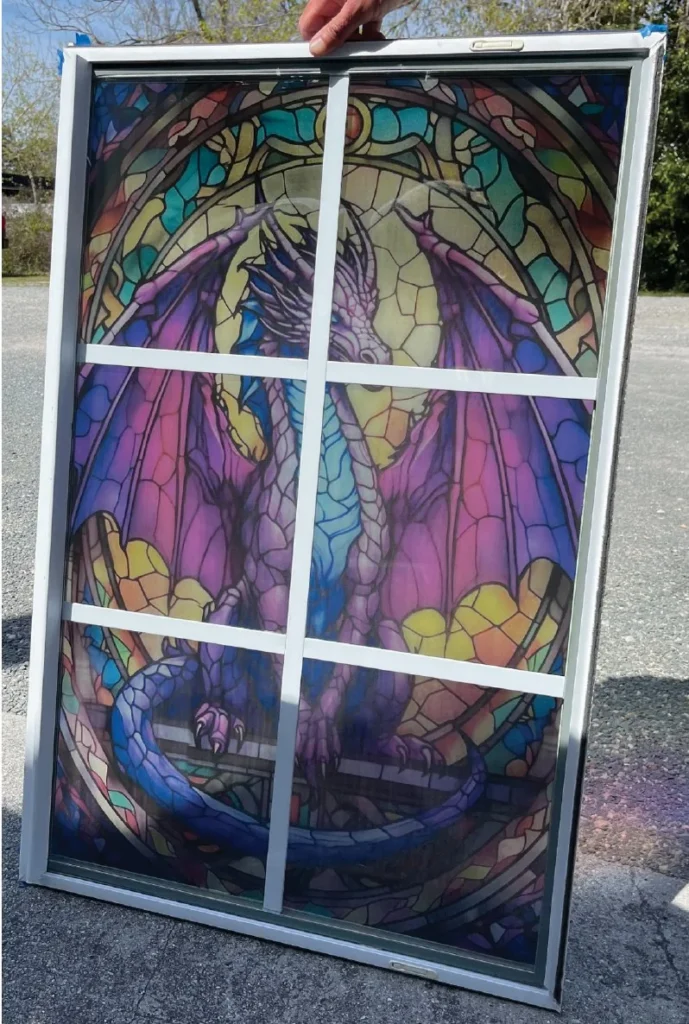
Glass, metal and wood. White ink is standard on all three machines, so color reads on dark and clear surfaces.
Where vinyl wins
Vinyl is a good product for a lot of jobs. These are the ones where we’d point you to it.
Temporary graphics. An event, a seasonal promotion, a trade show booth. If it comes down in a few weeks, film that peels off is the right tool.
Rentals and leases that forbid paint. If the lease says no paint or no alterations, a printed surface probably falls under that clause. Removable vinyl is easier to get approved. Our article on landlord permission and lease clauses covers what to ask.
Curved or deeply textured surfaces. The head prints close to the surface as it travels a straight path. Columns, vehicles, tight curves and deep profiles like corrugated metal are out of its reach. Vinyl wraps.
Very large runs of identical decals. If you need thousands of the same sticker, a roll printer and a cutter make them faster and for less per piece than printing each one in place.
Long outdoor life with no clear coat. Outdoors, the team will recommend whether a clear coat makes sense for your surface. If nobody will be around to coat it, an exterior-grade vinyl with its own laminate may be the simpler spec.
Two more limits. The vertical machines print up to 11 feet high and leave an unprinted edge of roughly 9 inches at one side, 14 at the other and 6 to 8 at the bottom. Taller or edge-to-edge work takes planning, panel stock printed in the shop, or vinyl.
How to choose for your job
Five questions settle most of it:
01
How long does it need to last? Weeks points to vinyl. Years points to printing.
02
Do you control the surface, or does a lease?
03
Is it flat enough for a track or a rolling machine?
04
Is it one graphic, or a thousand copies of one?
05
Inside or outside, and will anyone clear coat it?
If most answers point to printing, send a photo and the square footage, and we’ll tell you which machine fits.
Questions people ask
Is surface printing cheaper than vinyl?
In material, compare ink at about fifty cents a square foot against your current vinyl invoices. Then add your operator’s time at 10 to 20 sq ft an hour.
Can a printed graphic be removed like vinyl?
Not by peeling. On a painted surface, it’s removed by painting over it. For graphics that come down in weeks, vinyl is the better choice.
Does direct printing hold up outdoors?
Yes. Outdoors, ask the team whether a clear coat makes sense for your surface and exposure.
Weighing a job both ways?
Call the team at 910-632-0320. Bring the square footage and what you pay for vinyl today.
Want a recommendation for your space? Every space is different. Tell the team in Wilmington the surface, the space and what you want on it, and we’ll tell you how we’d print it.