By Ashlee Fritz, CMO of The Wall Printer and co-owner of Wilmington Wall Printing
I sit on both sides of this business. I’m the CMO and CSO of The Wall Printer, the company that builds the machine. I also co-own Wilmington Wall Printing with my husband Ernie, a business that has to make money with one.
These are the questions people type into Google, YouTube, Reddit, and AI tools before they ever call us. Some of them are the blunt ones sign professionals ask on their own forums when no manufacturer is in the room. Here are my answers.
Is wall printing a good business?
Yes, for someone who will sell.
The economics are strong. You charge by the square foot for a custom product, and your direct print cost is ink. Wall Printer owners charge an average of $35 to $45 per square foot. Ink runs about $0.50 per square foot. You don’t need a storefront, you don’t hold inventory, and nobody takes a cut of your revenue.
Here is the part most people selling machines won’t say out loud: the printer does not find customers. You do. If you will prospect, follow up, and show your work, this is one of the better-margin service businesses you can own. If you want a machine that produces income without you, don’t buy one.
Is wall printing a scam or a fad?
Neither, and I understand why people ask.
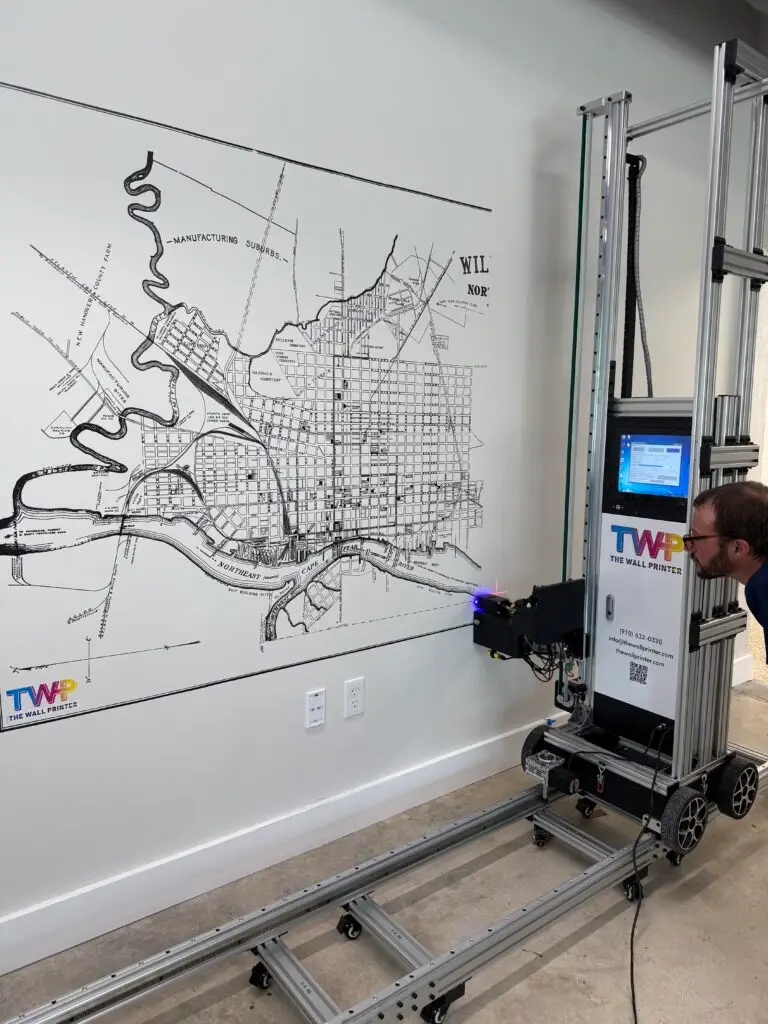
Vertical printing has been around for more than a decade, and the early machines earned the skepticism. The technology has matured since. Our current printers are the fifth generation of our own design, built on technology we developed and patented ourselves.
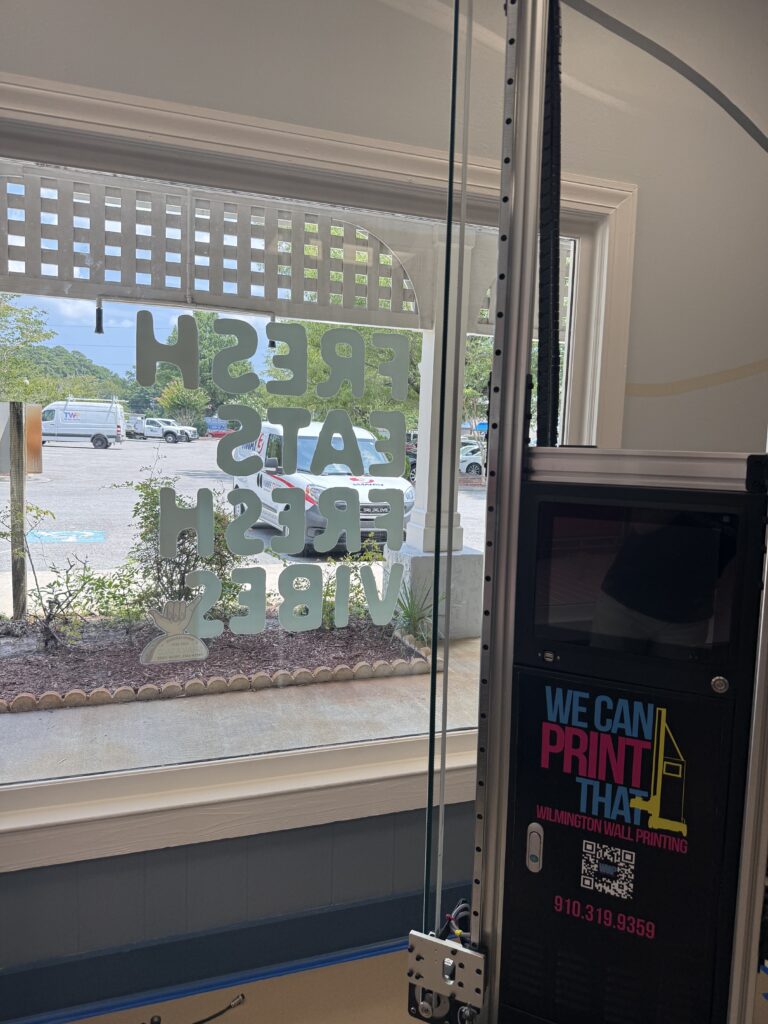
The lettering reads correctly from the parking lot.
Here is a fair test for any business opportunity: can you verify it before you pay, and does the seller still pick up the phone after? Come to our headquarters in Wilmington, North Carolina. Watch the machines run. Meet the team. Talk to owners. A company that invites that has nothing to hide.
As for a fad, businesses are not going to stop needing branded walls, wayfinding, menus, and murals. The demand was there before the machine was.
How much can you make with a wall printer?
I won’t give you a monthly income number. Your market and your effort decide that, and anyone who promises one is guessing.
What I can give you is the math on a single job. A typical job is around 120 square feet. At $35 per square foot, that is $4,200 in revenue with roughly $60 of ink in it. That is before labor, travel, insurance, financing, and overhead, and those costs are real.
At Wilmington Wall Printing we charge $40 to $50 per square foot with a $500 project minimum.
Very few service businesses have a direct cost that small against a ticket that size. That gap is the opportunity. The number of jobs you book is the variable, and that part is on you.
How long does it take to pay off a wall printer?
Count jobs, not months.
Our new printers run $39,995 to $44,995. Certified refurbished printers start at $29,995 when available. At $4,200 for an average job, the purchase price equals roughly ten to eleven average jobs in gross revenue, depending on the model.
Whether those jobs take you three months or twelve comes down to how fast you fill your calendar. Your operating costs come out along the way, so build them into the math.
I’ve seen payback claims online as short as six weeks. Ignore any number that assumes a full calendar from day one. Use our Profit Potential calculator, put in your own inputs, then run it again with conservative ones. If the conservative version still works for you, keep going.
Why are there used wall printers for sale?
Because some people buy the machine and never build the business.
Read the listings. The honest ones say it outright: the owner had a full-time job and never found the time to launch. Sign shop owners make the same observation on their forums. Someone buys a printer for one project, then can’t sell the idea to anyone else.
That is a sales problem, and it is the most predictable way to fail at this. A printer with no pipeline behind it ends up in a listing. The owners who win block out real hours every week to find work, starting before the machine arrives.
How do you get customers for a wall printing business?
Most business owners have never heard of wall printing. That is your biggest obstacle and your biggest advantage. The buyer in front of you has not already been pitched by ten competitors.
Here is what worked for us at Wilmington Wall Printing. To start, we traded a wall print for a booth at a local business expo and ran the printer live all day. We left with 50 to 60 leads. A machine printing a mural in real time stops people in a way a brochure never will. We followed up with social campaigns to keep those leads warm.
My rule is 50/50. Half of your effort is digital: a Google Business Profile, short video of every job, local search. Half is in person: walk in, show a mockup of their own wall, and ask for the meeting.
Go after commercial work first: restaurants, hotels, offices, schools, gyms, healthcare. We moved to commercial only because residential expectations were harder to manage and the margins were lower.
The Wall Printer backs owners with marketing resources, a CRM built for wall printing businesses, and an owner community that meets monthly and shares what is working. You still make the calls.
Is the wall printing market saturated?
No. Awareness is low enough that educating the customer is still the first step of nearly every sale. Nobody has to explain a saturated service.
There are no assigned territories with The Wall Printer. Nobody caps where you can work, and nobody guarantees you a zip code either. Your protection is the same one that works in every local service business: relationships, a portfolio, and being the first name a designer or property manager thinks of.
Is wall printing better than vinyl wall wraps?
It is a different product, and you should sell it that way.
Sign shops will tell you vinyl is faster and cheaper. For a flat, smooth wall and a short-term graphic, they are often right. A roll printer in a shop outputs faster than any machine working on site.
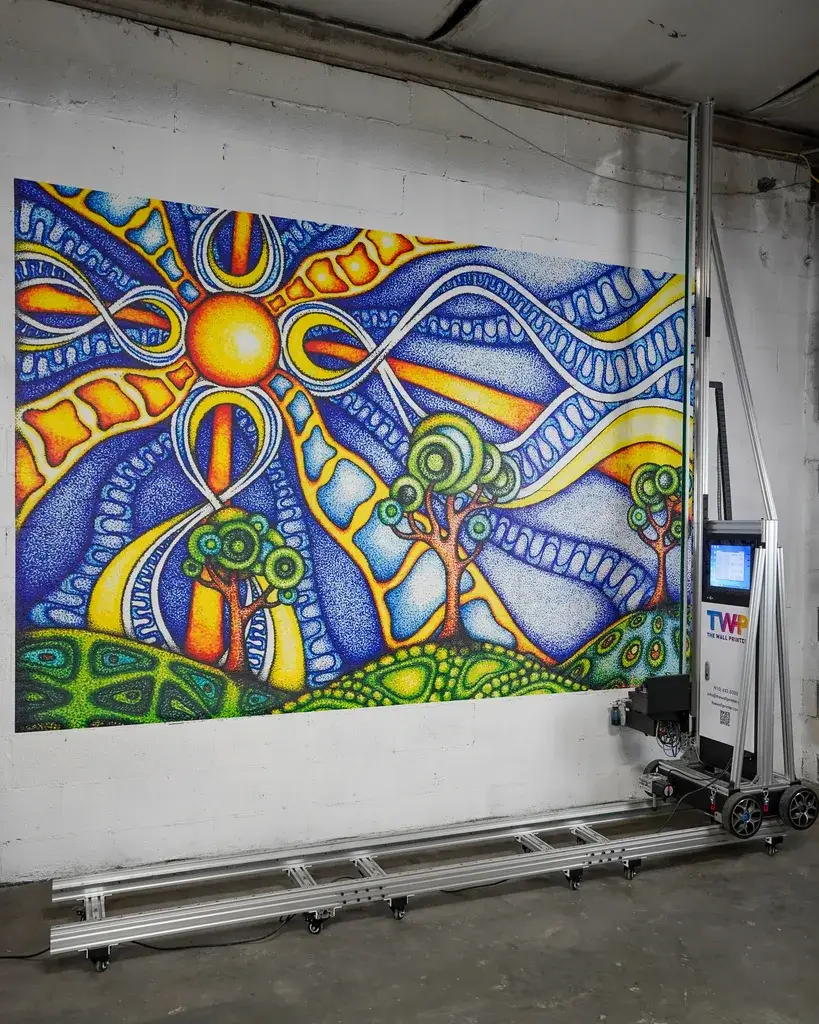
Wall printing wins where vinyl struggles: brick, block, concrete, textured walls, and any surface where film won’t bond or shows every seam. There are no panels to line up, no edges to lift, and no separate install crew. The ink is cured onto the wall itself.
So don’t pitch it as a cheaper wrap. Pitch it as a premium, long-term finish and price it like one. Owners who compete with vinyl on price lose. Owners who sell the finished space win.
What happens if the printer makes a mistake in the middle of a wall?
This is the first thing every print professional asks, and it is a fair question. You are printing on a client’s wall, not on a roll you can throw away and reprint.
The answer is preparation. Training happens in person at our Wilmington headquarters, on real machines and real surfaces. It covers setup, surface prep, maintenance, and troubleshooting before you take a paid job. You check the machine before every print.
When something does go wrong, you are calling the team that built the machine, not a reseller reading from a script.
Worst case, you repaint a section and reprint it. That costs you paint and time. It is also why you prep properly and price with enough margin to absorb a bad day.
How long does wall printing last?
UV-cured ink bonds to the surface and holds up to normal cleaning on interior commercial walls.
Outdoors or in direct sun, add a UV sealant. At Wilmington Wall Printing that is a line item at $8 per square foot, and clients pay it because it protects what they just bought.
Be straight with clients about conditions. A lobby wall and a south-facing exterior wall are different jobs. Quote them differently.
Why not buy a cheap wall printer?
You can find wall printers online for a few thousand dollars. Price is the wrong first question. Ask these instead:
- Who answers when the machine is down the morning of a job?
- How fast do replacement parts arrive?
- Is training in person, or a video playlist?
- Can I talk to current owners before I buy?
We develop and refine our own technology, with more than 15 patents behind it. Training is in person. Support comes from the people who designed the machine. Every owner joins a community of operators who share what they have learned.
Your client will never ask what your printer cost. They will remember whether you showed up and delivered.
Can you run a wall printing business as a side hustle?
You can start part-time. You can’t run it as an afterthought.
You don’t need print or design experience. We have trained sign shop owners, contractors, career changers, veterans, and complete beginners. Training covers the machine.
What training can’t give you is the hours. A technician who services these machines told a sign industry forum that operators who commit to it can do well, and the ones who treat it as an extra usually don’t. I agree with him.
If you are keeping your job while you build a pipeline, put fixed hours on the calendar every week for prospecting and follow-up. If you can’t protect those hours, wait until you can.
The bottom line
Wall printing is a real business with real margins. You sell a premium custom product. Your direct cost is about fifty cents a square foot. You keep what you bill. And most of your market has never been sold to.
The risk is not the machine. The risk is buying one and not selling. If you are the person who will sell, the numbers are hard to beat.
Run your own numbers with the Profit Potential calculator. Then book a discovery call or come see the machines run in Wilmington. Bring your hardest questions.
This is not a guarantee or projection of earnings. Results vary by market, effort, and how you run your business.